Mycelium reads a forest floor before anything surfaces. MushCrypto reads your validators the same way.
MushCrypto sits alongside your validators and reads their vitals continuously — no dashboards to babysit, no gaps in coverage.
Across every validator we sense, not a single cherry-picked node.
From the moment a vital changes to the moment someone's paged.
Celestia, Axelar, Akash and Shentu — see the full list below.
Every anomaly we've caught has reached someone.
Like mycelium, MushCrypto expands in stages — from a single sensor to a network you can finally see.
A lightweight agent drops onto each validator, sensing conditions without adding load or touching keys.
Sensors link into a dense, connected mesh that shares signal instantly across every network you run.
One dashboard, clear alerts — the only visible part of a system that's watching everything underneath.
Lineserve's founder and CTO, Stephen Ndegwa, is part of our team and leads the data center side of our work. Four people, from the data center floor to the governance vote.
Hardware, network and capacity for our Celestia setup in Lineserve's Nairobi data center.
Runs our validators on Axelar, Akash and Shentu mainnet and on Celestia Mocha. Owns key custody, upgrade scheduling and the working relationship with Lineserve.
Responsible for our servers in the Nairobi data center: the consensus node, the separate Fibre machine and the private link that connects them. Runs Axelar's tofnd and vald services and wrote the monitoring sensor.
Maintains the Validator Governance Scorecard, which grades 96 Celestia validators on their voting record and refreshes hourly. Keeps our public node guides current and prepares our governance votes.
Real proposals, real turnout — the same reconstruction the Scorecard runs, grouped by the chain that voted.

Pay for IBC Middleware Audits
Increase SignedBlocksWindow slashing parameter
Increase max square size, block size to 32 MiB
Recover IBC clients with KYVE

Gaia v23.2.0 Upgrade
Gaia v27.5.0 Upgrade
Gaia v28.0.0 Upgrade
Recover IBC Client for Gravity Bridge

Recover expired IBC client for Dyson Protocol
Recover IBC light client for EVMOS Network
Migrate Protocol USDC to Alloyed USDC
Recover IBC light client for XRPL EVM
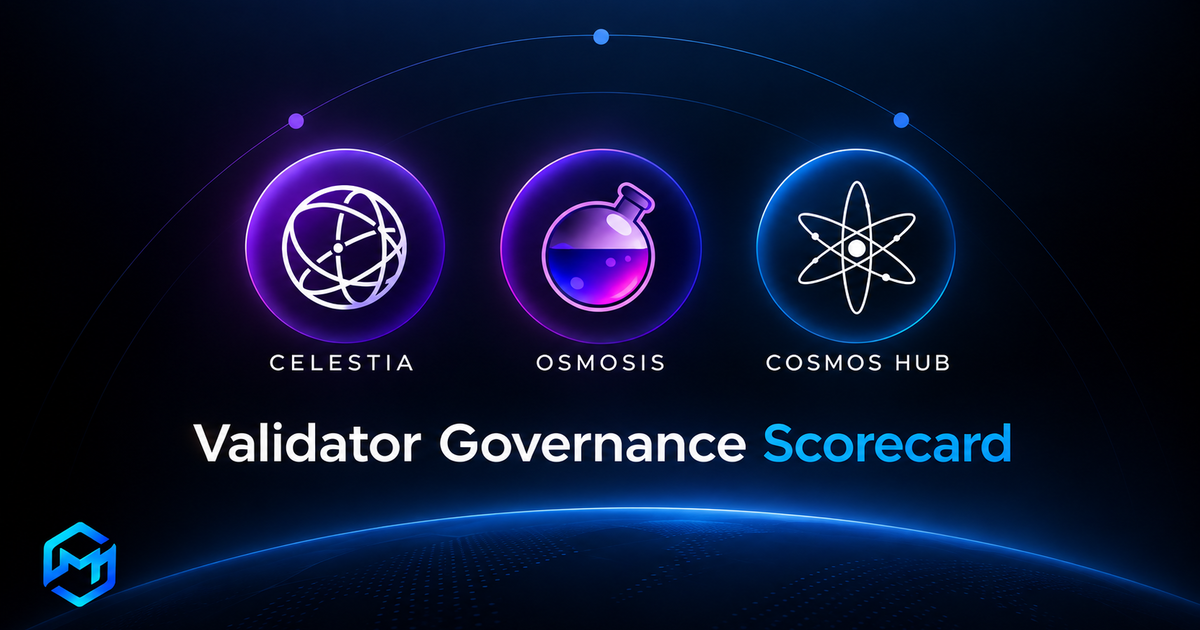 Open the scorecard
The scorecard is maintained by our software developer and governance analyst. Meet the crew
Our infrastructure is hosted in Lineserve's data center in Nairobi, Kenya, and we work with Lineserve directly.
Site datasheetLineserve, Nairobi data center
lineserve.net/datacentersThe practical value is the short distance between decision and hardware.
The private link, the DDoS profile and the move onto Lineserve's dedicated servers for mainnet were each agreed directly with the people who rack the machines.
Mainnet will run in the same data center, on the same network, as our Mocha setup does today.
Everything below links to something that actually runs — not a demo, not a mockup.
Participation reconstructed from full on-chain voting history across every Celestia governance proposal — not self-reported numbers, not a sample.
Open the scorecard44.5% average participation · live, updated hourly
Hardware requirements, systemd units, troubleshooting, a glossary that doesn't assume you already know the jargon. Written by people who run the nodes.
Read the docsSetup
Node types, hardware, light & bridge setup
Operate
systemd auto-restart, RPC & metrics
Support
Troubleshooting, glossary
Each validator below is live on-chain, with signatures and uptime independently verifiable through its native explorer. No proxies, no claims we can't substantiate.
Celestia
Modular data-availability network built so rollups can scale without re-posting history on their execution layer.
Testnet
mocha-4
 Axelar
Cross-chain messaging infrastructure, with validators jointly signing General Message Passing between dozens of chains.
Mainnet
axelar-dojo-1
 Akash
Decentralized compute marketplace where providers bid to run container workloads, settled on-chain in AKT.
Mainnet
akashnet-2
 Shentu
Security-focused Cosmos network with on-chain risk and audit infrastructure.
Mainnet
shentu-2.2
If this doesn't cover it, the contact section below will.
No. The sensor only reads what's already public or exposed to it — node vitals, peer health, signing behavior. No key access and no control-plane changes, ever.
Node vitals are continuous, not polled on a schedule. The Governance Scorecard recomputes hourly against the chain — nothing here is a weekly snapshot someone forgot to update.
A bonded validator with zero recorded votes across every proposal we track, verified against raw chain data — not a self-reported gap, and not an assumption from a missing field.
It alerts you. Under 120ms from the moment a vital changes to the moment someone's paged — the dashboard is there for when you want to look, not something you have to babysit.